Saturday, 9 February 2013

THX 1138 (1971)


THX 1138 is a strange and rather unique sci-fi movie directed by George Lucas, his first feature film.

The story is set in the distant future in a city populated by shaven headed individuals, clad in white robes and tunics. Sex is outlawed and the administration of psychotropic drugs is compulsory in order one presumes to take the inhabitants' minds off their joyless existence and keep their libidos at bay. The stringent laws are upheld by cyborgs who are dressed a bit like motorcycle cops with metal masks. All inhabitants of the city are referred to by a series of letters and numbers, and our focus is drawn to the THX 1138 (Robert Duvall) of the title who's menial job involves the dangerous manufacturing of the law enforcing robots involving plutonium and explosives.

THX has a roomate LUH (Maggie McOmie), whose job is to maintian CCTV monitoring of the city's population, basically to make sure they are taking their drugs and not copping off with each other. However LUH herself hasn't been taking her medication and consequently forms a crush on THX. When she substitutes his pills for dudds her feelings are reciprocated and the two begin an affair. But LUH's superior SEN (Donald Pleasence) realises something is up and thows suspicion on the couple alerting the authorities to their misdemeaners.
Although there is a fair deal of hi-tech gubbins going we are mainly in the realm of a dystopian future with many references to sex crime and Big Brother. And like Orwell's classic novel 1984, the many powers and committees that oversee THX's world aren't exactly infallible. Bureaucratic errors are made on a daily basis. Many of the city's inhabitants are imprisoned wrongly for the most minuscule of crimes. And health and safety would have a field day with the lack of preventative measures in place to keep the dangerous workplaces accident free. This is not a wealthy society either. Fighting crime and punishment is on a definite budget with law enforcers instructed to give up the chase once finances go over a certain amount.

Religion also plays a big part in THX 1138. The city is littered with tiny uni-chapels where unhappy citizens can repent, confess and seek advice to the ever-watching, ever present deity OMM 0910. These portatemples resemble phone boxes and give out automated advice such as "Work hard. Increase production. Prevent accidents and be happy." Shades of Radiohead's mantra from OK Computer... "Fitter, Happier, More Productive"?
THX was released at the turn of the 70s but it was actually conceived as a student project by Lucas in the late 60s along with his friend and Hollywood sound guru Walter Murch (who provides a curious soundtrack of machines, cars, intercoms and computerised noises). It very much has the feel of a student film with a lot of art house, anger and politics as well as a strong scent of the revolutionary times from whence it was borne.
As a result it's also a bit pretentious and slightly unfathomable at times, a bit like Last Year at Marienbad set in the future. What saves it is Lucas's original vision of a world set mostly in stark, pure white. In fact you'll rarely see so much brilliant white lovingly photographed on the screen as you will in THX 1138, and for that reason it's pretty unique and worth sticking with.

It's also one of a handful of films made in the 1970s that depict future dystopias. The Planet of The Apes series set the bar for post-apocalyptic civilisations throughout the decade and Soylent Green and The Omega Man followed suit to varying degrees of success (all starring Charlton Heston strangely enough). Logan's Run also takes a lot from THX thematically and in concept.
If Orwell is a major influence on the themes at the heart of THX, then Philip K Dick is another sci fi writer who's mark is there to see. The idea of hallucogenics and pharmaceuticals being dished out by authorities to keep the public's minds sedated is an idea used in Dick's classic novel A Scanner Darkly (published after THX was released). Surveillance and levels of reality are also prevalent motifs in Dick's work, although he instills a lot more humour into the darkness than Lucas does here.

George Lucas's name has been in the movie news a lot recently but I'm trying to work out what exactly it is he does these days apart from earning pots of cash from the Star Wars franchise (although passing on the baton to JJ Abrams is a good move). Makes me wonder though what happened to the fresh faced ingenue who was at the forefront of the 70s US Brat Pack along with Coppola, Scorsese, Speilberg and all those other legendary filmmakers.

Don't get me wrong, you can't really knock the man who created the ultimate cinematic cult and revolutionised the way we look at technology in movies. But a look at IMDB shows that creative output as a film director over the years has been low and even on his more prominent production side, George Lucas's name sits next to a fair few turkeys (Howard the Duck anyone?)


THX 1138 is no turkey. It shows an original vision on a large canvas. I just wish that we'd seen more of that vision over the last 40 years.


Mindlock...

Saturday, 19 January 2013

Hard Eight (1996)

Happy January people! I went to see The Master the other day, Paul Thomas Anderson's new film. I have to say that I found it slightly disappointing. Sure it's a very theatrical film with an amazing feel for period and costume (all those amazing neck ties, suits and print dresses!) and unsurprisingly it's top heavy on the method acting and dialogue. However for all it's style, symbolism and cinematic flourishes I thought it was lacking a little in substance and intensity... a bit like one of Lancaster Dodd's overwrought speeches, full of colour, sound and fury but signifying a bit less than that.

It got me thinking about Anderson though and his movie trajectory. His films, although sharing similar themes, have changed so much over the years. They seem to be getting more and more extreme in style and substance which can only be a good thing. His previous film There Will Be Blood was a perfect marriage of passionate film making and original vision... helped a bit by Daniel Day Lewis. I guess that's why I was a bit disappointed with The Master. I just felt it didn't have a strong enough narrative or resolution, despite an interesting left-field approach.
 
Anyway with all this in mind I thought now would be a good chance to revisit Anderson's first feature Hard Eight, an engrossing tale of winners and losers set around the gambling halls of Vegas and Reno.

Drifter John is sitting destitute outside a diner on the outskirts of Las Vegas when old timer Sydney chances across him and offers him a cigarette and a cup of coffee. Over coffee it turns out that John has been trying to gamble his way to $6000 so that he can bury his mother, but only has $50 left for a stake. Sydney, apparently motiveless, offers to help John by lending him money and teaching him a few tricks of the trade in how to make a little stake go a long way. Suspicious at first, John slowly lets himself get taken under Sydney's wing and before long the pair are fast friends with Sydney taking a paternal role in the relationship.

Fast forward two years and John has followed Sydney to Reno where the pair are regular faces in the casinos. He's befriended by waitress Clementine and "security" man Jimmy who Sydney takes an instant dislike to. But events are about to spiral out of control as fatal flaws in all four characters are revealed.
 
The stunning opening sequence in the diner sets the tone for this intimate epic. The camera work and framing are on point as is the use of music, both soupy background FM schlock and then the louder sweeping horns as John makes his decision to take up Sydney's offer. Hard Eight, like all of Anderson's films, is a character piece first and foremost and a chance for the actors to flex their muscles with some meaty roles.
 
The main man here is Philip Baker Hall who proves integrity personified as old timer Sydney (an role written specifically for him). On the other side of the table is baby-faced John C Reilly as John, all boyish charm and puppy dog eyes. Supporting the two leads are Gwyneth Paltrow as the vulnerable Clementine and Samuel L Jackson as the sleazy and somewhat threatening Jimmy. Jackson obviously relishes playing the bad apple in this fool's paradise and there is always a sense of unease when he is on screen. Look out also for an entertaining cameo from Anderson regular Philip Seymour Hoffman as a drunk gambler trying to outwit Sydney at the crap table.
 
Anderson really has a feel for how people talk in certain situations and all the actors convincingly convey base emotions of fear, desire, love and hate with help of a great script. Indeed dialogue is king in most of the director's movies and here the scenery is fairly chewed up as the screenplay crackles off the screen. Coupled with the writing and first rate performances is Anderson's keen eye for a camera angle. He knows exactly how to use his lens, when to track, when to zoom, and when to stay put - all in service to the actors and the script. It makes Hard Eight a riveting film to watch.
 
Once in Vegas, Anderson's eye for realism doesn't let up. This is a Vegas with very little glitz or glamour, inhabited by characters going nowhere in some kind of ever decreasing gambling circle of hell. The Hangover it ain't. What we do have in abundance is a strong sense of morals between men, even in the face of some pretty immoral behaviour. Friendship, chivalry and selflessness are strong themes here, mostly personified by Sydney. From the outset Sydney comes across as a font of knowledge and good advice, proclaiming homespun pearls of wisdom like "Never ignore a man's courtesy." If Vegas is the wild west of gambling the Sydney is the old gunslinger rolling his last dice... obviously his old fashioned morals are set to be challenged by younger pups.
 
Sydney obviously sees himself as a father figure in this respect. Families, patriarchs and offspring are recurring themes in Anderson's films. Think of Jack Horner and Dirk in Boogie Nights or the fathers and sons/daughters in Magnolia who are haunted by their sins. Even Adam Sandler in Punch Drunk Love comes from an overbearing family of sisters.
 
Hard Eight has all the components of a late night movie - gambling, smoking, drinking, broken hearts, lost lives and dark secrets. The Hard Eight of the title refers to an ultimate impossible bet when shooting craps. A few characters go for it throughout the film, ironically the one who succeeds in winning on it ends up dead. Well Shackalaka-dooby-doo.
 
Watch Hard Eight here...

Tuesday, 6 November 2012

Bob Roberts (1992)


Time for a change of pace after all that blood and guts, and as it's US election time, a great chance to stay up late and watch this political satire whilst votes are counted and swing-states determined.

Directed by and starring famous Hollywood liberal Tim Robbins, Bob Roberts is a mockumentary in the style of This is Spinal Tap with hints of Don't Look Back and Tanner '88. It follows a Pennsylvanian political campaign fought between Republican Bob Roberts (played by Robbins) and Democrat Brickley Paiste (played with humility by the late, great Gore Vidal). The prize is a place in the US Senate House. The film within the film is "directed" by British documentary producer Terry Manchester (character actor Brian Murray), who provides an objective sounding board for the political battleground in front of him.

Coming across as a folk hero for the far right, musician Roberts courts his public with rousing country rock concerts and staged public appearances. His self-penned songs rip into 1960s idealism, tearing them to shreds whilst also targeting drug users and the "lazy" (i.e. unemployed). His policies are very much back to basics, full of idealistic soundbites that promise wealth and a return to family values. However it becomes obvious as the story progresses that it's the poor and the minorities, both ethnic and sexual, whose livelihoods are threatened by Roberts' politics. Working behind the scenes is a team of wheelers, dealers and spin doctors who keep Roberts' campaign on the road and moving in the right direction. Needless to say, dirty tricks are never off the table.

Central to the strength of Roberts' popularity is campaign manager Chet MacGregor (an oily performance by David Lynch favourite Ray Wise) and the shady finances of campaign chairman Lukas Hart III (Alan Rickman, scary). But as Hart's unsavoury background is exposed to the public, so is Roberts' success and integrity threatened, and there are far left factions determined to expose Roberts, Hart and the campaign as fraudulent.

I see a lot of comparisons with Tim Robbins' Bob Roberts and the man that is Mitt Romney. Both seek to court left of centre votes with promises that are made to be broken. Both look like butter wouldn't melt in their mouths. Both use religion as major tools of their trade to garner the votes of the American heartland. And they both spell absolute disaster and Armageddon should they reach power. It's men like Roberts that have stopped many of Obama's policies going through the Senate, which is one of the reasons why it seems not much has been acheived since he came to power.

By the time you read this, it's more than likely that America will have decided who they want to reside in The White House for the next term. At the time of writing it's neck and neck but looking like Obama is going to hold on to his position. I sincerely hope he does because should Romney get in then, with extreme right-wing politics both sides of the Atlantic, we could all be in for a long cold winter...

This next song is dedicated to YOU!

Monday, 29 October 2012

The Cabin in The Woods (2012)


Two more days to Halloween (Halloween, Halloween) so it's time to bring out the big guns, and there's no recent horror film much bigger than this year's The Cabin in The Woods. Now I'm not one for spoilers, so I'm going to attempt to write this without giving the game away... which isn't going to be easy. Safe to say the tag line of "You think you know the story" has never been more appropriate. Quite frankly, you don't.

Directed, written and produced by a dream team of Drew Goddard (Buffy, Cloverfield) and Joss Whedon (Buffy again, Firefly, The Avengers), Cabin in The Woods is a film that totally defies expectations, whilst at the same time intensely satisfying them. It pokes a whole lot of fun at the horror genre (referencing a tonne of classics in it's wake), whilst never letting it's grip of the tension go slack, and at the same time creating something truly original, surprising and downright terrifying.

It's the weekend and five college kids looking for fun and frolics are heading on a road trip into the woods to stay at a remote cabin. They are your stereotypical cannon fodder - the jock, the cheerleader, the stoner, the intellectual/sensitive type and the virgin. On the road the five encounter a deserted gas station with a very creepy attendant, a harbinger of doom if you like, who warns them obliquely of the perils that lay ahead. In fact we've already been primed that bad stuff is going to happen with a fascinating credit sequence featuring ominous scenes of death, destruction, fire and brimstone, all graphically enhanced in a deep blood red glow. The rest of the film doesn't disappoint.

As their campervan heads back on the road and towards their final destination, a birds eye view surveys their journey (shades of the opening to The Shining?) through a beautiful and foreboding landscape, and an eagle flies gracefully overhead... Once arrived at the cabin, things start to get weird. A game of truth or dare brings on some very strange behaviour, and once the cellar door springs sharply open, all bets are off and the game has well and truly begun.

Goddard and Whedon handle the suspense perfectly whilst never giving too much away. The drama is set up early doors so we know from near the outset things aren't quite what they seem. However not until the stupendous final denouement do we discover what dark and terrible secrets lay beneath the cabin's floorboards. The script itself is sharp and witty enough to engage even the most sceptical of viewers, without being cheesy or too formulaic. Performance wise there's not a duff note played amongst the leads. Fran Kanz is the standout as the Shaggy-like stoner Marty whilst Kristin Connolly does an excellent turn as the prudish yet steely Dana. Look out also for a surprising cameo from a cult player of horror movies past...

Cabin in The Woods has references a plenty for spotters. Evil Deads 1 and 2, I Know What You Did Last Summer, Silence of The Lambs, Friday 13th, Hellraiser and Wolf Creek are just a few of the classics given a nod and a wink to in passing. But in no way is the film just a series of homages to your favourite horror films. Deep down it slyly explores why and how we love being scared whilst also making a comment on what that says about us. And if all this sounds like some sterile scientific experiment analysing the rules of the genre, then think again. Cabin in The Woods is a thrilling ride into unexpected and uncharted waters.

It's difficult to see where the horror film can go from Cabin in The Woods. What new and surprising twists can be brought to a genre that looks to have been bled dry? In a month where Paranormal Activity 4 (yawn!) is opening as well as a rerun of The Shining (albeit with extra footage), things aren't looking that fresh or exciting for horror fans. It's to Goddard and Whedon's credit that they have created a proper bar-raiser, leaving the rest of their peers trailing in their wake. I mean, who knew that unicorns could be so deadly?

Truth or Dare...

Friday, 19 October 2012

Dawn of The Dead (1978)


We continue Shocktober, with the don dada of zombie films - the original Dawn of the Dead. Directed by legendary undead supremo George A Romero, Dawn of The Dead is a must see for anyone interested in horror flicks. Both funny and terrifying whilst also providing an offbeat social comment on the times, the film holds celebrated status and deserves high residence on any Top 10 of the genre. Dawn of The Dead is a sequel to Romero's first feature Night of The Living Dead which itself was a bit of a game-changer when it was released back in 1968. It's also part of a long catalogue of zombie films helmed by and involving Romero including Day of The Dead and Diary of the Dead. There was a pretty decent remake of Dawn of The Dead made by Zack Snyder in 2004, but this is the original bad boy.

Made 10 years after Night, Dawn of The Dead picks up where the former leaves off. It's three weeks after the initial outbreak and the flesh eaters are wreaking merry hell across the United States. Martial law is in place across the country and gun totin' SWAT teams are called upon to attack those infected. Chaos reigns and law, order and civilisation in general seems to be on a downward curve.

The devastation is reported in chaotic broadcasts by Philadelphia news station WGON, where eye in the sky pilot Stephen and his girlfriend Francine work. The pair plan their escape using the network's helicopter and aim to pick up Stephen's SWAT mate Roger on the way. Meanwhile Roger and fellow armed police Peter are busy battling a strange combo of zombies and hippies in a tenement block in the city - a particularly grizzly sequence. Once done they hook up with Stephen and Francine in the chopper and head for anywhere but here in the hope of finding refuge.

Needing somewhere to land, rest and refuel, the foursome happen across Monroeville shopping mall which is, yes you've guessed it, full of zombies! Refusing to flee, the protagonists choose to sit out the pandemic in a secluded part of the mall, dodging zombies and living off what's on sale. But the ghouls are getting ever closer, and it's not long before their consumerist paradise is under threat.

The zombies themselves are of the classic mould - stumbling, groping, unstable and slow on their feet. In fact it's a wonder how they are able to kill or feed off any living creature. There's a lot of comedy falling over by victims and a lot of standing and screaming as their adversaries approach at an agonising pace to claim their next meal. The flesh eaters do however look horrific and that's down to the make-up skills of Tom Savini. A Vietnam vet, it was Savini who came up with the blue/grey tint to the skin which is now a zombie staple. The contrast between the skin and the bright red day-glo blood only enhances the gore when it flows.

"What are they doing? Why do they come here" asks Francine of the zombies. "Some kind of instinct" replies Stephen. "Memory of what they used to do. This was an important place in their lives." It's one of the key pieces of dialogue of the whole film. Maybe in late 1970s America there's not much difference between shoppers before and after they become zombiefied? I mean they act the same way, aimlessly wandering the isles, gawping gormlessly at what's on show. And it also asks questions about how a zombie thinks. At what point do you realise that your life amongst the living has ended and that you have become part of the legion of the undead? Zombies must have some form of intelligence otherwise they wouldn't come back to the shopping mall where they spent so much of their lives.

Philosophical musings aside, all four lead roles are well rounded with distinguishing characteristics. "Flyboy" Stephen is ever so slightly camp in his aviators and pilot's jacket, and clearly not in tune with basic means of survival. Francine is resourceful, realistic and handy with a snipers rifle. Roger is reckless and slightly immature whereas cigar smoking Peter is the brains of the team, calm and collected and always with a strategy at hand. All the actors do what is expected of them without too many embarrassing moments - in particular Scott Reiniger (current Prince of Ghor in Afghanistan, WTF?) makes Roger a very watchable presence.

Romero knows where to point his camera and there is some elegant framing of shots amid the blood and body parts. Our old friends Goblin provide another memorable score with the help of Suspiria director Dario Argento (who also acted as mentor to Romero in pre-production). Unlike the foreboding music of Argento's classic, their throbbing music in Dawn of The Dead verges on the disco and wouldn't sound out of place in the nightclubs of New York, Dalston or Vauxhall.

Dawn of The Dead may not be the most violent of the zombie canon, or even the scariest, but it more than holds it's own in the horror stakes and it's certainly one of the most iconic. What it lacks slightly in scares it makes up for with an impending sense of doom and apocalypse. There's a real sense that this is the shopping centre at the end of the world, a paean to capitalism gone wrong set against the grey American winter skies. The world of Dawn of The Dead is a world where credit is redundant and ammunition and groceries rule... and even they turn out to be useless in the end. It's a world where there is no respect for mortality and the dead are cursed to walk the earth. There's no more room in hell...


Saturday, 6 October 2012

Witchfinder General (1968)

 
Next up on the late show is Witchfinder General, a British horror film from the late 60s starring the king of camp and macabre Mr Vincent Price. It's a period piece set in the mid 17th century at the time of the English Civil War. If you know your history then you'll realise we're talking Roundheads vs Cavaliers, Oliver Cromwell vs Charles II, and a total breakdown of society in general. All this provides a pretty grim backdrop to a sinister tale of greed, corruption and sadistic witch hunts.
 
Vincent Price plays lawyer Matthew Hopkins, the self proclaimed Witchfinder General who stalks East Anglia torturing suspected witches into confessing their heresy and evil ways under the banner of God's work. Bringing the muscle is his sidekick John Stearne, a bruiser with an appetite for beer, wenches and inflicting pain on the innocent. And it is mostly the innocent who pay the price as Hopkins and Stearne take advantage of the vacuum of law and order, reaping the financial benefits on offer for ridding villages of their local witches.
 
Fighting the good fight is brave Roundhead soldier Richard Marshall. After saving his the life of his commanding officer, Marshall is given a few days leave to visit his sweetheart Sara and her priest uncle John Lowes. But hot on Sara and Lowes' trail are Hopkins and Stearne, hoping to prove that the priest has the Devil's Mark on him and hoping to convict him of witchcraft.
 
If what's been described so far doesn't sound particularly scary then think again. Witchfinder General deals in a very perverse brand of horror, and although we're talking mainly tomato ketchup, there's a fair deal of gore. The accused witches are mostly tortured with what look like long knitting needles in order to discover The Devil's Mark. The trick is if the needles find an area of the body that produces no screams then the victim must be a witch and should be hung or burnt at the stake (a particularly nasty scene). Another way of seeking out the witchery is to lower the accused into the nearest river. Those that float are witches and must be executed. Those that drown... well let's just say it's a no-win situation if you fall under Matthew Hopkins' suspicion.
 
In his greed, corruption and merciless nature Hopkins is the personification of pure evil and Vincent Price revels in a role tailor-made for him. With a haircut and facial furniture not too dissimilar to Deep Purple keyboard player John Lord, Price hams up the sinister vibes to great affect. His glee at murdering blameless victims is priceless. "She was innocent" he murmurs with a sickly smile and a raise of the eyebrow as an accused witch is dredged dead from the river. It's classic Vincent Price.
 
The support cast is a who's who of late 60s minor British character actors. Robert Russell is memorable as vile and repulsive henchman John Stearne. Ian Ogilvy (he of The Return of The Saint fame) does a good turn as the clean cut hero Marshall. 1964 Pipe Smoker of the Year winner Rupert Davies groans and bleeds a lot as accused priest Lowes. And gravel voiced Patrick Wymark (top spy in Where Eagles Dare) makes a blink and you'll miss it cameo as Oliver Cromwell.
 
Sharing equal billing with Price and the C-list of character actors is the English countryside, beautifully shot by director Michael Reeves. Reeves shows much reverence for his locations and pastoral Britain has rarely looked better. There are tracking shots aplenty as the camera follows Marshall on horseback, galloping through fields and meadows in search of revenge to the rousing theme tune. In fact Reeves' Britain in the 17th century is something akin to the Wild West with Hopkins as the classic "villain in black". In the absence of a just and fair legal system, death is lurking at the end of every hedgerow. And for the barren deserts and ghost towns of the mid-west, read the bucolic pastures of Brandeston, Suffolk.
 
Witchfinder General is most definitely a horror film though. For one thing it has one of the largest and loudest scream counts of any horror film ever made. In fact the film fades to sepia on a piercing and bloodcurdling scream, which echoes over the gentle theme tune providing a very bitter aftertaste to the final reel. Witchfinder General met with howls of disapproval on release. Even though many of the more violent scenes were cut by the censors, it seems the sadistic nature of the film was too much for the critics and public of 1968. Sadly Reeves took his own life at the age of 25 not long after Witchfinder General was released. It was only his third feature film. Today it's regarded as a cult horror classic and a testimony to an all to brief career.

Watch the whole of Witchfinder General here...

Friday, 21 September 2012

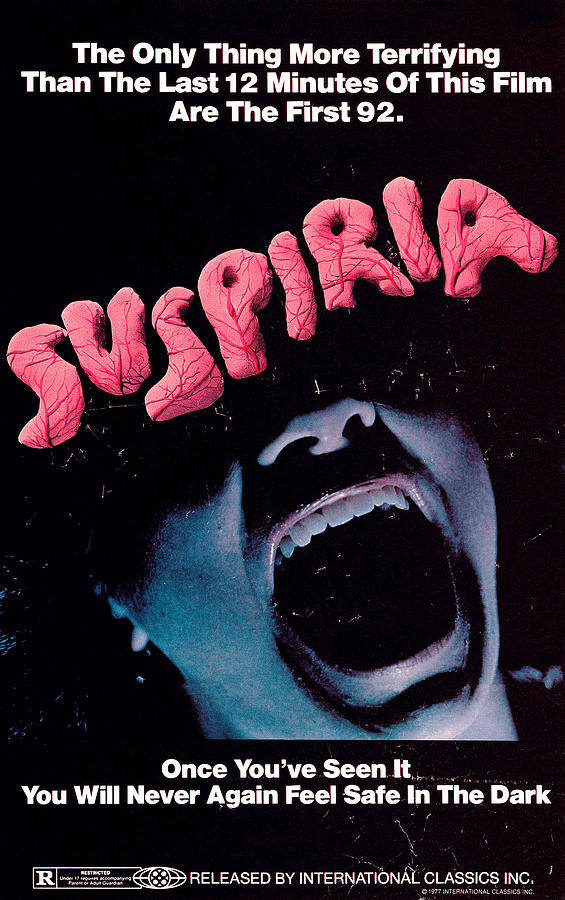
Suspiria (1977)


As we head towards October, the season of the witch, it seems right that we celebrate some midnight horror films. And what better place to start than Suspiria, Dario Argento's art-house horror masterpiece from 1977. I remember seeing this at the Scala in King's Cross on the back of a late night double bill with Driller Killer. This was when you could smoke in cinemas, bring in cans of red stripe and get the nightbus home. Naturally it was full of blokes.

The movie is a prime example of a Giallo, the lurid Italian horror genre of the 60s and 70s of which Argento was a prime mover and shaker. Indeed Suspiria's intense colours and hyper sense of reality make it one of the best looking horror films ever made. Argento brings a classic style and depth of vision to the simple but effective storyline. What the movie has in style, it matches in suspense, compounding terror and hysteria. Suspiria bites hard with plenty of look away moments. It's not for the faint hearted.

The story is set in a Munich ballet school for girls. Suzy (a skull-like Jessica Harper) arrives one night off the plane in a nightmarish storm and heads for the Freiburg dance school where she has a placement. There she takes classes under the imposing Miss Tanner (Italian 1940s starlet Valli) while the faculty is run by the civil but curt Madame Blanc. And when expelled student Pat gets (very) brutally murdered by a mysterious black gloved hand, things take a turn for the strange and grotesque. Sure enough it's not long before Suzy discovers some pretty freaky things going on at Freiburg...

It's fair to say Argento eschews a believable narrative in favour of dragging out as much tension and chills as possible from the plot. We are deep in supernatural territory here and anything goes especially the surreal. Everything is aimed towards unsettling the viewer and if you love being scared then that's what you tune in for.

Italian prog rock band Goblin provide one of THE great horror soundtracks, an eerie lullaby that really hangs around after the final reel. Suspiria was one of the last films to use Technicolour, and primary colours are intensified beyond belief throughout the film. The dark blue silks of the walls inside the academy look plush and opulent whilst the blood red hallways outside the girls dorms are foreboding. The film is shot using anamorphic lenses which stretch the action across the screen and this heightens the senses further. Argento does not stint on the scares or macabre either. Maggots fall through the ceiling on the unsuspecting girls and beware the snarling crazed dog of the blind piano player. At one point Suzy and room-mate Sara go for a late night swim in the large ornate swimming pool in the academy basement. It's a superb example of mounting suspense and exploitation of the girls' vulnerability.

Argento's roving camera is always up for a strange angle in the name of art, tracking, panning, zooming constantly. Sometimes we see the action as a reflection from the other side of a mirror say, or a window. Mirrors and windows are continuing motifs throughout the film, whether broken or intact. The art direction as a whole in Suspiria is on point. Argento fills his scenes with art deco Italian furniture and wallpapers. In fact the whole films looks like that other great Italian art deco film, Bertolucci's The Conformist.

You can see echoes of Suspiria's style in Tony Scott's (RIP) 80s vampire flick The Hunger. The film also heavily influenced music videos trends from the early 80s, especially in those made by Julien Temple for The Rolling Stones and Depeche Mode. And Darren Aronofsky owes a huge debt to Suspiria to great effect in his own giallo of 2010, Black Swan. 35 years after it was made Suspiria still has the power to shock and scare the wits out of anyone who watches it. For fans of the genre, you can't ask for more than that.


Friday, 14 September 2012

Bring Me the Head of Alfredo Garcia (1974)

Been a long time since we rock and roll, so let's get back in the saddle with some classic mid-70s Sam Peckinpah. Bring Me the Head of Alfredo Garcia is definitely one of Peckinpah's most personal films, although the sentimentality is a bitter one and it never gets in the way of a cracking tale with deeply Gothic undertones. The story starts as young pregnant Mexican girl Teresa is brought before her father and local Mr Big, El Jefe. The patriarch commands his henchmen to break her arm before she reveals the name of the father - Alfredo Garcia. El Jefe orders for the head of Garcia to be brought to him, and hires a ruthless team of bounty hunters/killers to find him, decapitate him, and bring back the proof.

Cut to Mexico City and said hitmen pick up gigolo Garcia's trail through Bennie, a one time soldier and now a down on his luck piano player, holed up in a shady bar of tourists, ex pats and gringos. Bennie takes the job of finding his old pal "Al" Garcia (who he discovers is already dead and buried) on the promise of a ten grand payoff, and what follows is a dark and twisted road movie through the Mexican countryside as Bennie and prostitute girlfriend Elita (also Garcia's ex lover) go in search of Garcia's grave, the bounty and the head.

Warren Oates gives one of his most iconic performances as Bennie. On the surface Bennie is a money grabbing loser who constantly wears the same crumpled suit, clip tie and shades and is ready to play any tune requested, even murder. However Oates instills an air of resolve and integrity in Bennie. He is genuinely disgusted at his adversaries' violent attitude towards women. In fact he is the only male character in the film that treats women with any kind of respect and tenderness. Against all the odds, all he really wants is a better life for himself and Elita, hence his pursuit of the money. "Nobody loses forever" he spits as he starts his journey.

The film is really Bennie's story and Oates relishes playing the lead after a lifetime of memorable cameos and bit parts. Sure Bennie is a tad unhygienic (washing crabs from his nether regions with tequila anyone?). But his all or nothing death-wish in search of the prize gives the plot it's main drive and as such, Oates gives Bennie enough balls and gusto to keep the viewer interested through the two hour running time.

Also worth mentioning are the two nameless hitmen who head the search for Garcia. Clad in business suits and callously efficient, the pair are played by tough guy actor Robert Webber and the slightly effeminate Gig Young. Young nonchalantly tells Benny his name is Fred C. Dobbs - a reference to John Huston's classic gold digging tale The Treasure of the Sierra Madre, one of Peckinpah's main go-to points for Bring Me the Head. Kris Kristofferson also pops up on the road through Mexico as a rape-happy biker. And although not on screen for long, Emilio Fernandez brings an ominous presence to the film as Mexican gang-lord and top villain El Jefe. Fernandez had played a similar role as Mapache in Peckinpah's game-changing western The Wild Bunch a few years previous and brings menace and barbarism to proceedings here.

The film is Sam Peckinpah's baby though. After having his previous effort Pat Garrett and Billy the Kid slashed to smithereens by the studio, he took full control of Bring Me the Head, shooting on a small budget with locations and actors he knew and trusted to seal the deal. Peckinpah's eye for detail and colour is never better. The photography is both clear and vivid as we swap the seedy hotel rooms of Mexico City, piped with muzak and lit with neon strips and lava lamps, for the dusty backroads and hues of pastoral Mexico.
 
Deep down Bring Me the Head is another of Peckinpah's many westerns. When the movie starts, it seems that we are in familiar territory, the turn of the 19th/20th century perhaps and the end of the old west? However the convoy of 1970s American cars that leave El Jefe's hideout in search of Garcia is disorientating and, as a noisy jet lands in Mexico city, we realise that this is the modern world. The traditional western themes are all there - betrayal, honour, greed and revenge. It's just that the action is played out with automatic pistols and machine guns instead of Colts and Winchesters.
 
The biggest signifier that we are in cowboy territory though is in Peckinpah's use of Mexico. Mexico was always Peckinpah's spiritual home, so many of his characters have sought refuge or ended their days there. Billy the Kid holes up in his hacienda south of the border waiting for Pat Garrett to turn up for the last gunfight. Pike, Dutch and the rest of The Wild Bunch reach their end game at Mapache's palace in a hail of bullets, blood squibs and balletic slow motion photography. Even Doc McCoy ends up in Mexico in Peckinpah's "straight" action flick The Getaway. So, in it's own way, Bring Me the Head is Peckinpah's ode to the country and the myth that he helped create, that of Mexico as a land of wild and terrible freedom. And in Bennie we have Peckinpah's closest alter ego, an artist with a gun, at the end of his tether looking for a pot of blood-soaked gold...
 
"How you guys like baseball?"


Saturday, 28 January 2012

Down By Law (1986)

It's late. You are on your own, on the sofa, drinking coffee or maybe something a little stronger. If you smoke then you possibly have a cigarette on the go. Or maybe something a little stronger. It's a hot summer's night, the window is open and the lights and sounds of the street filter into the room. Your lady, fella, whoever has left you and you're seeking solace the only way you know, in the bosom of one of your favourite movies. You want to see one film and one film only. You want to watch Down By Law.

The story has a familiar premise, touching on both noir and new wave. Out of work DJ Zak (Tom Waits) and pimp Jack (John Lurie) are both set up for different crimes they did not commit and find themselves in Orleans Parish Prison in the same cell. It's pretty much hate at first sight and as time passes so their antagonism towards each other increases. The tension is broken up by their new cellmate, the Italian Bob (Roberto Benigni) who charms them with his homespun philosophies and colloquialisms into calling a truce with one another, before hatching a plan of escape. However the path to freedom is not an easy one, and once on the outside, the 3 cons have to rely on each other as well as their wits to stay alive in the Louisiana swamps.

Don't be fooled, this ain't your average prison break movie. Somewhat of a parable, Down By Law is an offbeat gem of a film about the foibles of human nature with intricately drawn characters and enough balls, style and essence of cool to keep you interested in a slow moving, yet engrossing storyline.

So how come it's this film that fits your mood? Perhaps it's the unlikely combination of it's three lead actors that does it for you. It's definitely a strange contrast. Avant-garde jazz musician John Lurie and singer/songwriter Tom Waits (fresh from Raindogs and Franks Wild Years) both posture to the camera in some sort of quasi-method as they are set up against the animated budding Italian comedian Roberto Benigni. Lurie looks and dresses like someone out of a 1950s gangster film, with his big features, suit and jazzy tie looking quite anachronistic for 1986. Waits with his chin warmer and DJ Lee Baby Sims rap is much more rooted in the present, a proper night owl to fit the spirit of the film. Benigni bounces off the pair of them and the walls, his wild hair and reactions more often than not the focus of attention when not much else is going on screen.

Or maybe it's the stunning black and white photography from Robby Müller? Sometimes roving, often just still, Müller's lens depicts the sweltering setting of pre-flood New Orleans and Louisiana - the streets, the houses, the tenement blocks, swamps and prison cells. Indeed at times the camera gives off as much attitude as the actors and Down By Law is a very beautiful film to watch.

More than likely though if you are watching this film then you prescribe to the unique and slightly twisted worldview of American independent film-maker Jim Jarmusch. Down By Law is more than the sum of it's parts and that is down to Jarmusch. From the initial moments when the first bars of Tom Waits' jagged bluesy Jockey Full of Bourbon strike whilst Müller's slow tracking montage of New Orleans life passes across the screen, through to the odd and somewhat open ending, Down By Law delights in its defiance of the rules of its genre.

A lot of this is down to the freestyle way the characters interact with each other. In fact the whole film has an improv feel to it. You can imagine Jarmusch sitting down with the actors, setting them a basic premise on which to act out the next scene, and then just letting it roll to see what happens, rather like a jam session. With the fresh comic touches of Benigni coming as light relief to the downbeat backstory and the actors opposite him, it's a plan that works brilliantly and makes for some very entertaining moments. The fact that it's Lurie who provides the film's dark jazzy score and Waits who's songs frame the movie just adds to the impression that Down By Law is a collaborative effort from all major players involved.

It's a tribute Jarmusch and all involved that you leave the film wanting to see more of Bob, Zack and Jack after the screen goes black. How do their stories continue? How do they end? In a crazy way a sequel going back to their lives further on down the line would be welcome. Because in Down By Law it is indeed a sad and beautiful world, and one that perhaps we can relate to.

Jailhouse Rock...

Sunday, 15 January 2012

The King of Comedy (1983)

This article was first published at Den of Geek last year, you can read it in full here

The names Martin Scorsese and Robert De Niro in tandem on a movie poster are a seal of quality for many a film lover. The pair have had a hand in some of the darkest and most thrilling moments that mainstream American cinema has had to offer, often making the blood curdle and the adrenalin shoot into overdrive. Their films together excel in exploring the outer limits of machismo, psychosis and extreme violence, with little or no regard for the censor or those of a nervous disposition. Taxi Driver, Mean Streets, Goodfellas, Raging Bull. These aren’t just your run of the mill Saturday drive-ins, these are some of the most original films of their time, and ones that get better with repeated viewings.

One film missing from that list is Scorsese’s biting satire on the nature of celebrity: The King of Comedy. Underappreciated at the time of release, it has been re-evaluated over the years and is now regarded as a major work in both their careers. The King of Comedy was Scorsese’s follow up to his award-winning boxing biopic Raging Bull, again with De Niro in the lead role. It was the opening film at Cannes in 1983 and was released later that year. Scorsese was actually set on making his torturous biblical epic The Last Temptation of Christ as his next film. However De Niro, coming off a Best Actor Oscar for his gruelling portrayal of Jake La Motta, wanted to make a comedy (can you blame him?), and presented Scorsese with a script that had been lying around Hollywood for years, written by film critic Paul Zimmerman.

Set in a noisy and bustling New York City, The King of Comedy tells the story of Rupert Pupkin, an autograph hunter verging on stalker and wannabe stand-up comedian, who daydreams his way into the life of his hero: talk-show host Jerry Langford. A chance encounter between the pair backstage after one of Jerry’s shows leads the delusional Rupert to believe he has a shot at stardom. However, after a series of knockbacks and humiliations, Rupert, along with his seriously unhinged female accomplice Masha, also a Jerry-worshipper, take matters into their own hands and kidnap Jerry in an attempt to fulfil both their dreams.

This is very much an actor’s movie driven by character, dialogue and a simple plot, rather than Scorsese’s usual frenetic camerawork and editing. De Niro plays totally against type as the naïve and hapless nobody Pupkin (“often mispronounced and misspelled”). With his hair plastered to his forehead in a terrible matted side-parting, his pencil moustache and cheesy grin spreading over his face, and his grey three-piece suit and red tie/hanky combo looking cheap and gimmicky, Rupert Pupkin is one of the all-time great cinematic geeks. It’s a brilliant characterisation from the award winning actor, and a long way from his heroic and macho roles in The Deer Hunter and The Godfather Part II.

De Niro’s finest moments come about during Rupert’s daydreams. These are mostly would-be scenarios that he imagines taking place between himself and Jerry. Rupert’s basement bedroom is a shrine to Jerry and the show, with life-sized cardboard cutouts of his idols and a full-scale mural of an enraptured audience, in front of which he practices his comedy routine. In a scarily funny interlude, Rupert, imagining that he now has his own talk show, conducts a one-sided conversation with said cutouts of both Liza Minnelli and Jerry as his guests until he’s interrupted by the shrill voice of his mother ordering him to keep the noise down. It’s De Niro at his loopy best, acting and reacting against silence as if in front of a CGI blue screen.

The film critic Pauline Kael has described Pupkin as “Jake La Motta without fists”. But surely Rupert bares closer resemblance to De Niro and Scorsese’s other great disturbed dreamer, Taxi Driver’s Travis Bickle? Both characters live out their lives as a daydream and at times the lines between fantasy and reality are misty to say the least. Both of their escapisms are born of frustration and alienation with the world at large.

Travis dreams his violent hallucinations with good intentions. His distress is spawned from what he sees around him and his wish for a better world. However, Rupert’s flights of fancy are totally tied up with his own dreams of celebrity and stardom. His total and undiluted faith in himself and his talents are as misplaced as his terrible jokes. So that when reality comes crashing home he takes desperate measures to fulfil what he believes to be his destiny as being crowned the new King of Comedy. Who is the more dangerous then – Travis or Rupert? Travis wants to help people. Rupert ends up threatening Jerry, the lines between love and hatred crossing over via our good, old friend: jealousy.

Alongside De Niro, acting honours go to Jerry Lewis as his namesake Jerry Langford and Sandra Bernhard as Masha. Lewis made a career of playing wacky, goofy roles in screwball comedies during the fifties and sixties alongside Dean Martin. In fact both Dean Martin and Frank Sinatra were considered for the role of Langford before Scorsese settled on Jerry Lewis, and the former funny man brings a weathered seriousness to the role. The pressures of celebrity are always apparent in the creases on his forehead, in his terror as he tries to exit backstage from a gig surrounded by baying and clawing fans, and in his pent-up rage when faced with a deluded Rupert turning up at his house in the Hamptons for the weekend. It’s a powerful and understated performance.

Bernhard provides an uncomfortable raw carnal presence as Masha, even more besotted with Jerry than Rupert is. Striding through midtown Manhattan stalking her prey, Bernhard plays Masha as a sexual terrorist who will stop at nothing to get her man. At that stage in her career, Bernhard was a budding stand-up comedian and she uses all the uncompromising improvisational skills she learned in the clubs to bring Masha to life. Her guerrilla tactics come to a head in Masha’s one scene alone with Jerry. Stripped to her underwear in her apartment, she sits opposite a gagged and gaffer-taped Jerry over a perfectly laid dinner table, informing him in no uncertain terms what the evening has in store for him. It’s a scene played to perfection by both actors, and also beautifully shot by Scorsese. Lit by candles alone, it is almost Kubrick-like in its clarity and eye for minute detail.

The King of Comedy has rich black humour in spades, celebrating the comedy of humiliation at its core. Not surprising then really, that a proud and Conservative Reagan-era America found it difficult to identify with the themes and characters on show. Indeed, The King of Comedy was a commercial and critical failure - “The Flop of the Year” as Entertainment Tonight announced it on air.

Despite its initial unpopularity, The King of Comedy is a very entertaining film. Along with Sidney Lumet’s Network, it’s one of the most insightful movies about the power of television and its effect on the TV generation. Today The King of Comedy has more relevance than ever. In a world where people will do anything to the point of embarrassment for their fifteen minutes, and where bog standard reality shows bestow celebrity and stardom on those with little or nothing to say for themselves, the movie has a harsh ring of truth. Is it really better to be a king for a night than a schmuck for a lifetime?

The fine line between fan and stalker...

Saturday, 7 January 2012

Rosemary's Baby (1968)


When I was 12 years old, for the summer holidays my parents hired a holiday cottage in the countryside for a couple of weeks. At night I used to sneak downstairs to watch films when they had gone to bed. I remember watching Rosemary's Baby late at night on BBC2, it must have been the first scary movie I ever watched. Needless to say, it petrified the living shit out of me. I couldn't sleep that night and even had to turn off the radio alarm clock next to my bed as the digits were throwing a strange green light around the room which looked like some kind of supernatural spirit. If any film gave me a love of late night cinema then it was this one.

Rosemary's Baby is still one of my favourite horror films. It's a beautiful movie to watch, shot in a dreamy soft focus haze with script, actors, makeup and musical score all manipulated by director Roman Polanski to create a sense of increasing fear and claustrophobia. It's beauty lies in the way it relies on psychological scares rather than on blood, guts and gore, of which there are very little. It really is a well crafted film, depicting a nightmarish take on one of the most natural and happy of situations - getting married, getting your own place and having kids.

Based on a novel by Ira Levin and adapted for the screen by Polanski, the story is simple but gripping. Young couple Guy and Rosemary Woodhouse move into The Bramford in New York, a Gothic apartment block with an unsavoury history of cannibalism and witchcraft. Guy is a struggling actor and Rosemary plays the dutiful wife, dreaming of kids and a happy life with her husband. Their neighbours are Roman and Minnie Castevet, a rather peculiar and sinister elderly couple who take an interest in the Woodehouses after their own young tenant commits suicide.

Guy begins to socialise with the Castevets whilst Rosemary prefers to stay at home. Guy's career simultaneously begins to take off and he and Rosemary try for children. On the designated night of conception Rosemary faints after eating some of Minnie's "chocolate mouse" and then suffers a bizarre delusional sequence where she is raped by the devil whilst the naked inhabitants of The Bramford (Minnie and Roman included) look on and chant in praise of Lucifer. In the morning it turns out that Guy had sex with her whilst she was passed out... and a few weeks later Rosemary discovers she is pregnant.

Polanski has a habit of setting his movies in claustrophobic environments - Repulsion, The Tenant and the soon to be released Carnage are all set in apartments whereas the main action of Cul de Sac takes place in a desolate lighthouse. He also delights in the unravelling of the psyche, especially the female one - Repulsion again, What? and parts of Chinatown and Bitter Moon being good examples.

In Rosemary's Baby, Guy and Rosemary's apartment seems to take on a life of it's own, in Rosemary's mind anyway. What starts as her ideal family home turns into a prison and the scene of her nightmares, quite literally in fact with one of the most realistic dream sequences committed to celluloid projected onto the wall and ceiling above her bed as she sleeps. Shot mostly from her point of view, we are never totally sure if the dream is really happening or whether it is all a figment of her imagination, much like the demonic plot that drives the story forward to it's perverse conclusion. As the uncertainties, pains and struggles of pregnancy continue, so increases Rosemary's paranoia and mistrust of all of those around her as her mind begins to fragment.

No scary movie is complete without a scary soundtrack and Polish jazz musician Krzysztof Komeda provides an excellent score to Rosemary's Baby with creepy clarinets and bassoons clamouring unexpectedly at shocking moments, mirroring the strange plot turns and unsettling camera angles that Polanski uses to heighten our sense of dread. This all serves to wind the tensions and suspense tightly, much in the manner of classic Hitchcock, and when the release and revelations come they are shocking and leave behind a distinctly bitter aftertaste.

Central to the success of the movie are excellent performances from Mia Farrow as Rosemary and John Cassavetes as Guy. Farrow brings a fragile innocence to the main role. Her sparkling blue eyes are so full of love and happiness at the beginning of the film, yet as the movie progresses they change drastically, widening in horror as her worst nightmares become reality. Cassavetes is the perfect choice for the self centred Guy, a little bit sleazy and totally caught up in his own pursuit of fame and fortune. Star of the show though is Ruth Gordon in an Oscar winning turn as nosey neighbour Minnie. Intrusive, fussy and oddly birdlike in her makeup and appearance she provides a disquieting presence with her home-made drinks, cakes and pendants that she pushes on the pregnant Rosemary. Also worth a mention is Sidney Blackmer as the equally alien looking Roman Castevet and Hollywood stalwart Ralph Bellamy as high society gyno Abe Sapirstein respectively.

The tragic aftermath to the release of Rosemary's Baby, the murder of Polanski's pregnant wife Sharon Tate by the Manson family the following year, is well documented. The bizarre events of her death left a shadow over Polanski's subsequent career with many of his films dealing with personal disasters, psychological breakdowns and the grotesque. The movie itself has left a large legacy on cinema as a whole. It's immediate influence can be seen in a wide range of 70s demon-shockers such as The Omen and The Exorcist, as well as in studies of the female mind such as Robert Altman's Images and French art house horror flick Possession. Most recently it was Darren Aranofsky's brilliant Black Swan that drew largely on the themes, mood and suspense generated by Polanski in Rosemary's Baby.

Rosemary's Baby is a must see film for horror aficionados and for those with a penchant for all things that concern the occult and witchcraft. It will keep you thinking and wondering long after the last bars of the strange lullaby theme tune have played and the TV screen fades to black. Anyone for Tannis?

The Black Bramford

Friday, 9 December 2011

Villain (1971)


Villain is a violent British gangster flick from the early 1970s. Set in and around London it's a classic tale of the decline and fall of East End gang leader and hard man Vic Dakin. Dakin's normal racket is blackmail and with the help of his cohort Wolfe he entices the aristocracy and members of parliament into ready made honey traps. However with the police on his tail and a rat in his gang, Dakin runs the gauntlet in organising a big money snatch on a security van. Vic has to compromise his plans by including a rival gang boss in the scheme and when the robbery is botched he's forced on the run, turning on his allies as the net closes in around him.

Villain is made from the same mould as Get Carter and The Long Good Friday although truth be told, it's probably not as good as either. It doesn't have the style of Get Carter or the political relevance of The Long Good Friday. What it does have going for it is a snarling and seething performance from Richard Burton as Vic Dakin. Throughout the 60s Burton was one of the biggest names in cinema, and one of Britain's most celebrated film stars. His fame had as much to do with his acting skills as it did his notorious drinking habits and stormy marriage to Elizabeth Taylor. Along with other such luminaries as Oliver Reed, Richard Harris and Peter O'Toole, Burton raised hell on every film set from Hollywood Hills to Pinewood Studios.

But by 1971, his star was on the wain. The iconic lead from "Night of The Iguana" and "The Spy Who Came in from The Cold" had resorted to making a series of big budget flops  with his real life co-star Elizabeth Taylor. Boom! was an overblown pretentious drama and The Comedians, although based on good source material by Graham Greene, was a mistake. The pair had bounced and riffed against each other drunkenly in Who's Afraid of Virginia Woolf but for the rest of the 60s their private and screen lives bled into one another and the pair lived and extravagant lifestyle of hangovers and public spats.

The role of Vik Dakin is quite obviously based on Ronnie Kray (with a touch of James Cagney in White Heat) and it lets Burton show off his brutal side. The violence is implicit right at the start when he uses a disloyal croupier as a punchbag before slicing off his tongue with a cut-throat blade for talking too much. The blood drips from the window that the dying man is hanging from and Burton quips "bleedin' pigeons". The next scene shows him returning home after a night out with the boys to his elderly and much loved mother who he dotes upon. The mother fixation is another link to The Krays, as is Burton's resonant East End accent (with a hint of the valleys peeking through) and his and his gang's dapper attire. Velvet suits, big ties, heavy leather overcoats and silk cravats and hankies abound. Dakin may not be as controlled as Michael Cain/Jack Carter but he's on a par in the cruelty and style awards. Also, no one looks more menacing and camp with a stocking over his head as Richard Burton.

Apart from his mother, the only other relationship Dakin has is an aggressive semi sexual one with Ian Mcshane's pimp and blackmailer Wolfe. It's an intriguing angle of the movie. Dakin obviously fancies Woolf and the only way he can express his desire in their main bedroom scene together is with his fists before the screen fades to black. Mcshane plays Wolfe with an easy charm, like a delinquent Lovejoy but attracted to and by both men and women. There's nothing tender about their liaison, in fact it's a very sadistic affair with Mcshane the submissive to Burton's threatening sugar daddy.

Alongside Burton and Mcshane, Joss Ackland gives a sterling and weaselly performance as Dakin's focus of hatred Ed Lowis, constantly sucking on chalk tablets to settle his bilious stomach ulcer. Donald Sindon is a sleazy presence as a dodgy MP and Del Henney, who starred in Sam Pekinpah's Straw Dogs the same year, gives it some menace as thug Webb.

Curiously Villain was scripted by comedy writers Dick Clements and Ian Le Frenais, with American actor Al Letieri (who specialised in playing gangsters himself) also getting a writing credit. Adapted from James Barlow's novel The Burdon of Proof, the script fairly crackles along with Burton getting to say some classic dialogue and one liners, all through his death mask grin. The film was directed by Michael Tuchner who has a filmography as long as your arm in television on IMDB. And Villain does has a very TV movie feel to it with low budget production values and a very quick and simple filming style. Even the claret, which flows freely, has a very ketchup look to it.

Unfortunately Villain did nothing to resurrect Burton's career and, bar his award winning role in Equus, the 70s was a lean patch for him (The Medusa Touch anyone?). Still he's at his very best as Vic Dakin and Villain is definitely worth a watch for Burton strutting his stuff and putting the frighteners on those burkes who lack respect - "Respect! Respect! You don't know what it is. Unless you're Vic Dakin. Tell 'im, someone. Tell him!"

Watch the whole movie here...