Monday, 11 April 2011
The Hill (1965)
Sidney Lumet died at the weekend and as a tribute I'm putting this one forward for the late show. The Hill is set in a North African military prison at some point during WWII. It's a typical story of sadistic guards and wardens vs the inmates who struggle to survive harsh life in the slammer. The prisoners themselves are inside for the pettiest of crimes yet are treated like grade one criminals. The Hill of the title refers to a mountain of sand in the middle of the camp that the prisoners are made to run up and down in the baking hot sun every day. Presiding over the regimented daily punishment routine is hard-ass warden Harry Andrews, who takes pleasure in breaking men down in order to build them up once more into toy soldiers. When one of the prisoners dies on The Hill, the whole system is called into question, fingers are pointed, and revolution is in the air...
The Hill is an engrossing and intelligent drama. The themes that run throughout the film range from the rebel's constant need to challenge authority and the faceless machine that runs it, through to the latent and not so latent racism inherent in British society. The film is shot in stark black and white to empahsise the contrast between the punishing African sun and the bleak interiors of the prison cells and guard's quarters. With lots of tight camera angles and many close ups, the strange clanging sounds from within the cells and sudden jerky camera movements only add to the rising tension.
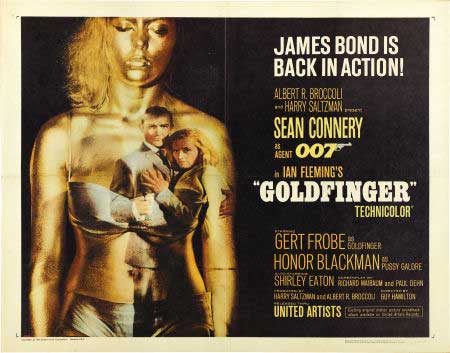
The film is also strangely stage-like, not surprising considering Lumet's off-Broadway background. You can imagine The Hill playing out in fringe theatre, a sparse set with the actors performing in front of and around the vast sand dune. The acting is uniformly excellent. Lumet always seemed to bring the best out of his actors in his films and this is no exception. Fresh from Goldfinger, Sean Connery stars as prisoner Sgt Joe Roberts, the main symbol of subordination and revolt. Connery excels in the role, his delight increasingly apparent as the system crumbles around him just as his frustration in his own inadequacies overwhelms him. Harry Andrews puts in one of his usual creepy performances as Warden Wilson whilst the two Ian's, Bannen and Hendry, play good and evil respectively as the two "staff" guards in charge of the day to day running of the prison. Even Roy Kinnear puts in a good turn.
The Hill isn't one of the more celebrated films of Sidney Lumet. It's been overshadowed somewhat by his albeit terrific 70s movies such as Serpico, Dog Day Afternoon and Network as well as his courtroom dramas 12 Angry Men and The Verdict and also his final film Before The Devil Knows You're Dead. To be honnest though, this list doesn't even touch the sides. Lumet made more than 45 films over the space of 50 years, and stayed at the top of the game throughout. He was a true American great.
RIP
Saturday, 2 April 2011
The Long Goodbye (1973)
See that guy in the top right hand corner of this blog? Curly black hair, dark suit, tie loose at his neck with the top button undone on his shirt? Looks like he's been dragged through a hedge backwards? That is Elliott Gould who stars as private detective Philip Marlowe in Robert Altman's 1973 classic The Long Goodbye. He's one of my favourite characters from the movies so he holds prime position at the top of this page. The film itself is a funny, knowing look at 1970s culture and private detective movies as a whole. A second viewing reveals the movie as some kind of experiment in deconstructing genres and a few myths of popular fiction. However don't let that put you off - on the surface The Long Goodbye has no high brow pretensions, it's just a damn fine film.
Loosely based on the 1953 novel by Raymond Chandler, the story begins with Marlowe being cajoled into driving his friend Terry Lennox south to Tijuana after Lennox claims to have had a run of the mill bust up with his wife Sylvia. On his return to LA, Marlowe is picked up by the police as an accessory to murder. Sylvia is dead and Lennox is the number one suspect. When Marlowe hears of Lennox's subsequent hotel suicide, he sets about trying to clear his friend's name and find the real murderer. Along the way he encounters a washed up alcoholic writer (superbly acted by Sterling Hayden) with wife in toe, a midget psychiatric "doctor", a psychopathic Jewish mobster and his gang of hoods and a bevy of half-naked chanting, yoga practising girls who live in the flat opposite.
Altman's film plays clever with both plot and themes, updating a post-war 1950s LA to the post-hippy fallout world of the 1970s. In essence the movie is a bit of an ode to Hollywood and the mass of black and white thrillers that populated cinemas and picture houses in the 30s, 40s and 50s. By setting the film in the 70s, Altman also draws comparisons between the selfish me generation of that era and a more innocent age when friendship, loyalty, morality and trust stood for something - themes that run through the majority of Chandler's work as well, although in the movie there is much humour and satire to soften the blow.
The Long Goodbye is a heavily stylised movie. The film is shot in golden textures by Vilmos Zsigmond and post flashed to add depth of colour. This means that the film is actually exposed slightly before developing so that the extra sunlight mutes the colours and creates a softer focus to what we see on screen. As such, it looks like we are watching the 1970s through a 1950s filter. Alongside this, Altman and Zsigmond use a continually moving and roaming camera, tracking, panning, zooming in and out through windows and mirrors, focusing on areas of the screen that seem insignificant and of interest only to the director, but actually serve to heighten the senses. Altman's use of John Williams' memorable theme tune also disorientates the viewer. The music plays almost constantly throughout the film in several different formats - from a jazzy lounge piano piece to a souped up supermarket background muzak, from Mexican flamenco guitar to a doorbell ring, and from a sitar led Far Eastern theme to a Yiddish tune hummed by Mark Rydell's gangster character Marty Augustine.
Central to the success of the movie as a whole is Elliott Gould's performance. At once shambolic, dishevelled and wise-cracking, Gould plays Marlowe as a man out of time - Rip van Marlowe. Constantly smoking (no one else smokes in 1970s health conscious LA) and chanting his mantra "It's OK with me" Gould drifts through the film always one step behind the plot. Roughed up, used and abused, and ultimately betrayed, it should come as no surprise when the worm turns at the climax.
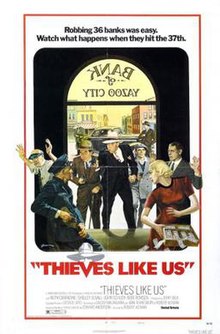
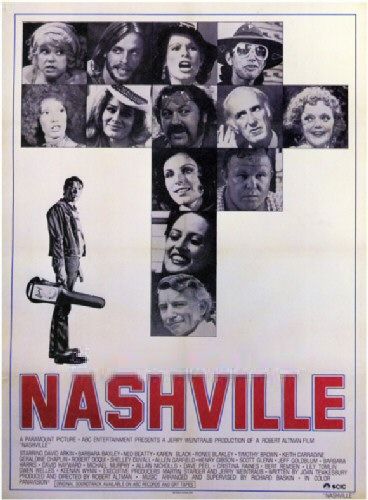
The Long Goodbye came bang smack in the middle of a rich run of form in Robert Altman's career - M.A.S.H., California Split, Thieves Like Us and Nashville all achieved either box office or critical success, sometimes both. It wasn't always the case, nobody produces gold forever, but right up until his death Altman was making his own films on his term sand we salute him for that.
Marlowe shares a drink on the beach with Roger Wade...
Friday, 18 March 2011
Trees Lounge (1996)
Trees Lounge is a film that celebrates the twin cultures of hard drinking and under-achievement. The movie follows the trials and tribulations of alcoholic Tommy (Steve Buscemi who also writes and directs) as he tries not very hard to put his life back together after losing both his job and girlfriend. Rather than attempting to mend his errant ways, he chooses instead to spend most of his time in the bar of the title and with the company of the flies that swarm around it. Given a chance to earn some cash driving his uncle's ice-cream van, Tommy soon attracts the attentions of sexually precocious teenager and distant relative Debbie.
Chanelling the spirits of Charles Bukowski, Raymond Carver and Tom Waits, Trees Lounge is a film steeped in the traditions of modern American independent cinema. Story-wise, nothing much really happens. There are no car-chases, no violent murders. None of the characters are on any mystical journeys towards self realisation or change. Most of the time they just sit on their barstools and drink, kvetch, flirt badly and let life pass them by. If this all sounds like a bad episode of Cheers then think again - behind the banter and darkly comic moments this is a gritty slice of real life to rank alongside the best from American indie-king John Cassavetes.
Steve Buscemi directs his first feature with the lightest of touches, using lots of natural light and a stationary camera. He obviously knows the subject matter well, his unheroic portrayal of Tommy has the benefit of a wealth of experience. We all know Buscemi as Mr Pink, Tony B and "Nucky" Thompson but he's rarely been more charismatic than in Trees Lounge. Backing him up is cool as f**k Chloe Sevigny as Debbie, who serves as a breath of fresh air in Tony's humdrum drunken existence. Also on show are Samuel L Jackson, Mark Boone Jr and Anthony LaPaglia plus a few familiar faces from The Sopranos.
Trees Lounge is an absolute gem and definitely worth staying up for, so pull down the blinds, crack open the bourbon and line the shots up along the bar.
The oldest trick in the book...
Monday, 24 January 2011
Into The Night (1985)

Jeff Goldblum stars in his first leading-man role as Ed Okin, an everyman who's world is falling apart around him. His suburban life is meaningless, he hates his job and he's suffering from a bad case of insomnia. After discovering his wife in bed with a co-worker he takes off one night with the intention of escaping his dull existance.
Instead he ends up rescuing damsel in distress Michelle Pfeiffer from the clutches of some murderous Iranian hitmen who are after a bunch of smuggled emeralds. What follows is a road/chase movie around mid 1980s LA via highways, hotels and motels, Beverly Hills mansions, Malibu beach houses, Hollywood film sets and the glamorous Marina Del Ray.
Los Angeles has been portrayed 1000 times on the silver screen, and whilst Into the Night is no classic, it has cult status. I guess the big problem with Into The Night is that it wants to be both an existential comedy/romance and a violent fast paced thriller. However the result is a film that's neither outrageously funny nor hugely exciting. An escapist's dream of a movie, it follows a pretty familiar narrative with it's fair share of cheesey dialogue and more than a few worn-out plot hooks.
Into the Night is, however, compulsive viewing for the late night movie fan. Jeff Goldblum's performance is one of superb understatement, his skin pale and his eyes heavy-lidded as insomnia grips him and there is real on screen chemistry between him and Michelle Pfeiffer. Added to that is a very inventive use of LA locations - the city looking bleached out and sundrenched in daylight whilst it shimmers in neon light by night.
The main talking point for film geeks is director John Landis's leftfield approach to bit-part casting. Following on from his big-time successes with Trading Places, An American Werewolf in London and The Blues Brothers (and Michael Jackson's Thriller video!), Landis decided to cast a whole host of his Hollywood film director friends in cameo roles. Blink and you'll miss... Don Siegel, Jonathan Demme, Lawrence Kasdan, Amy Heckerling, Paul Mazursky and David Cronenberg to name a few, alongside Landis himself as one of the four slightly comical Iranian killers.
The cast also includes such diverse character actors as Richard Farnsworth, Dan Ackroyd, Irene Papas and Vera Miles. Added into the mix are musical luminaries Carl "Blue Suede Shoes" Perkins and The Thin White Duke himself, David Bowie! In fact Bowie almost steals the show in his brief showing as English hitman Colin Morris, his knife fight with Carl Perkins one of the high points of the whole film.
Jeff Goldblum went onto great things from this. His very next film was The Fly which launched him into superstardom. Michelle Pfeiffer has also had a glittering career since Into The Night - critcal aclaim, nominations and awards followed her in many subsequent film roles. For Landis however, the film began a slow downward arc in his profession which resulted in such tripe as Spies Like Us, Beverly Hill's Cop III and Oscar (Sylvester Stallone's first and last foray into comedy). Sadly last year's attempted comeback Burke and Hare did little to change anyone's opinion that the funnybone is yet to be mended.
"You're very good..."
Sunday, 9 May 2010
Thunderbolt and Lightfoot (1974)
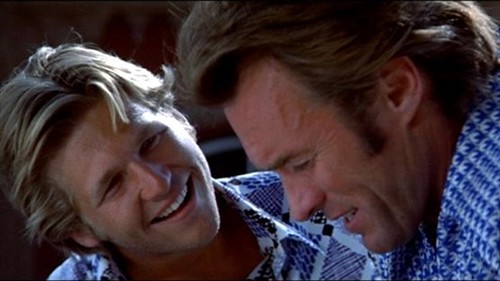
At first glance, Thunderbolt and Lightfoot is a simple heist movie with car chases, action sequences and male bonding galore. But scratch beneath the surface of the tetosterone fuelled wisecracks and gunplay and you'll find a sensitive road movie about desperate characters coming to terms with age, loss and their own mortality.
Set against the golden, sun drenched highways of the midwest, the story develops from a chance encounter on the road between Eastwood's phoney preacher fleeing from a mid sermon shoot-out and Bridges' car stealing, hedonistic drifter fresh from lifting a 73 Trans Am. On the run and with nothing to loose, the pair pitch in with each other, stealing cars, picking up girls and wearing some stylish wide collared mid 70s shirts. However hot on Eastwood's trail is very very bad guy "Red" Leary (menacingly played by George Kennedy), and his not so bad henchman Goody who are keen to recover stolen money from a previous bank heist that Eastwood helmed years before. After a hectic car chase and violent confrontation, the four flawed characters join forces uneasily to rob the same bank again...
Into this simple narrative, first time director Michael Cimino weaves classic Western themes of male bonding and friendship (which at times seem a little too friendly!), keeping up with changing times and the attempt to realise the American Dream. However the movie never gets bogged down in introspection - the pace never lets up, the dialogue is snappy and very funny and the set pieces are supremely handled. Cimino went onto big things from this - The Deer Hunter a few years later sealed his name in American film history, just as Heaven's Gate (somewhat unfairly) almost erased it. Eastwood, as we all know, is now a cinematic legend both behind and in front of the camera and this was possibly the movie that showed a slightly softer side to his screen persona than was evident in Dirty Harry and The Dollars Trilogy. But the film is as much Bridges' as anyone's and he often steals the show as the reckless good-time chasing Lightfoot, none more so when having to dress up in drag as a decoy for the robbery.
A word too about the theme tune - Paul Williams' classic peice of americana songwriting "Where do we go from here" suits the movie's mood perfectly. It was also covered by the king of rock and roll himself, Mr Elvis Presley... but it's in the film's somewhat melancholy final moments that the music comes to the fore, as Eastwood pulls on his sunglasses, snaps his cigar into the ashtray and drives off down the desolate highway.
Watch Eastwood and Bridges take a ride with a psychotic, bunny shooting redneck here...
Thursday, 4 March 2010
Build My Gallows High (1947)
Build My Gallows High has all the ingredients of film noir in spades. The film is essentially a three hander. Robert Mitchum is never better as the smart talking doomed hero, cigarette hanging loosely from his bottom lip as he helplessly watches the demons of his past catching up with him and propelling him to his destiny. Equally good is Jane Greer as the most beautiful and devious of femme fatales, her eyes intently focused as she watches two men fighting over her. Kirk Douglas completes the triangle as the shady, oily gambler, menace and violence thinly concealed behind his grimace as he draws Mitchum back into the dark pool of their shared history (the film was actually called "Out of the Past" on it's release in the US).
The script literally sings off the screen with the snappiest of dialogue and first person monologues which seem to have a poetic jazzy rhythm all of their own. The narrative plays out full of lies, lust, deception and betrayal, crosses, double crosses, all of them perfectly threaded through the plot as director Jacques Tourneur and his scriptwriters (one of who is uncredited crime novelist James M.Cain) create a mean world where men are foolish fated creatures and women end up holding all the cards. The film is really Mitchum's. He is on screen for the entirety of the movie yet his performance seems effortless as he drives dreamlike to his fate, eyes half closed, disenchanted half smile playing on his face.
Build My Gallows High was remade in the 80s as (cue Phil Collins soundtrack) "Against all Odds" with Jeff Bridges, James Woods and Rachel Ward. The story was also used as the basis for the instantly forgettable Tony Scott/Kevin Costner turkey "Revenge" in the 90s. You don't need to watch either of those, go straight to the original and accept no substitute. Now do you wanna talk business or do you wanna play house?
Watch Robert Mitchum and Jane Greer going loco down in Acapulco here...
Tuesday, 16 February 2010
Diva (1981)
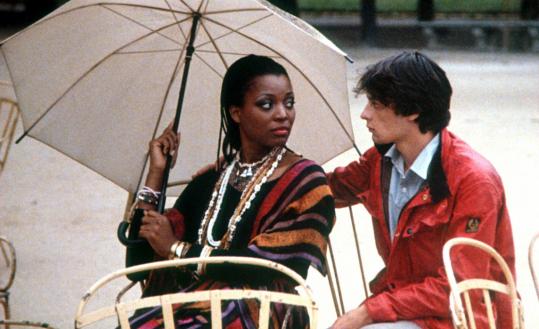
Set in the Paris of the early 80s, Diva is the story of moped riding postie Jules and his obsession with opera singer Cynthia Williams. The film begins with Cynthia (played by real life opera singer Wilhelmenia Wiggins Fernandez) performing a stunning rendition of the main aria from Catalini's "La Wally". After bootlegging a recording of this performance (Cynthia forbids live recordings as it is against her art) and stealing her gown, Jules finds himself in the middle of a plot involving the murder of a prostitute, a drug trafficking ring, a C90 tape incriminating the villains, and a pair of strange Taiwanese businessmen who are after the tapes he has made.
Diva is very much a film of it's era. Released almost 30 years ago, it's actually aged very well, which is surprising considering that at times it resembles an extended 80s pop promo. At the time it heralded a new era of French New Wave - the "Cinema of Look", and the empahasis of the film is most definitely on image, art direction and mise en scene. A romantic walk at dawn through Paris is beautifully shot in natural light to the tune of a touching piano melody. Jules's bare flat where he lives and dreams of opera is decorated only with giant pop art murals and mashed up cars. The scenes featuring the menacing (and slightly comical) villains strutting through the Parisian streets are accompanied by a fashionable disco-punk soundtrack.
The style over substance is most readily apparent in the scenes featuring Jules's existentialist recluse friend Gorodish, enigmatically played by Richard Bohringer. In his arty loft appartment he sits in his bath smoking cigars whilst listening to ambient music and contemplating the waves whilst a tank of water tilts from side to side and a jumbo jigsaw puzzle lays unfinished on the floor.
What saves all of this from being a complete pretentious mess is that writer/director Jean-Jacques Beiniex knows when to stick his tongue firmly in his cheek, and it's to his credit that the plot holds up under the weight of the imagery with some genuinely comic touches. You can definitely see Diva's influence in the movies of both Ridley and Tony Scott, in look if not in content, and Michael Mann along with his contemporaries Luc Besson and Leo Carax who directed Les Amants du Pont-Neuf.
Beiniex went on to make the art house smash Betty Blue but after that went off on his own artistic tangent and as a result his movies became marginalised by the film business and critics alike. To be fair, he has rarely hit the hights of Diva since. A telling line in the movie comes when Cynthia is asked why she refuses to make recordings of her voice.
“It is up to commerce to adapt to art, and not art to adapt to commerce" she replies - an accurate summary of Beineix's career for sure.
Watch Jules and Cynthia stroll through Paris at dawn here...
Subscribe to:
Posts (Atom)